
Conversational analytics is the here-and-now in the evolution of traditional analytics and business intelligence in the workplace. In an age of access to immediate answers in our personal lives—from online banking to researching DIY home improvement projects to seeking out a recipe for the perfect beef bolognese—it’s only natural to expect the same at work.
Under pressure to exceed performance goals and outperform targets, sales teams are a perfect example of those who need quick and reliable answers. AI-powered tools that can provide the information they need to prepare for meetings, prioritize outreach activities, and maximize quality time spent with clients and prospects continue to grow in popularity and adoption. ZoomInfo’s Go-to-Market Survey: The State of AI in Sales & Marketing 2025 revealed that AI—including the most frequently used tools, chatbots—increases the productivity of GTM professionals by 47%, cutting low-value, manual tasks by an average of 12 hours per week. And 89% of sellers say AI deepens customer understanding according to the Salesforce State of Sales 2026 report. Even as adoption grows, the ability of these systems to engender trust in the data, definitions, and answers they delivere will be a key factor in determining the value they create.
Our clients are pursuing similar results from their AI investments, particularly AI-powered analytics that equip teams with decision-making insights. For one of our Fortune 500 clients in the life sciences space, their journey to conversational analytics recently hit a major milestone as they pilot a solution that will equip nearly 1,000 of their salespeople now and eventually be rolled out to its global sales force of 10,000+ across 50 countries. But why was it a journey, and what were the challenges that had to be overcome to make conversing with data a reality?
Many of the challenges can be attributed to the high-stakes realities of the sales function itself. It’s no secret that a great sales organization is highly mobile, fast-paced, and has a performance-driven culture. Reps are on-the-go, not sitting behind desks with the luxury of time for data analysis. Their measurement of success changes as the business evolves; new products are added, territories re-align, back-end systems are upgraded and migrated. On top of change, there can be a high barrier to entry just to get up to speed, especially in organizations that have existed for decades. There are acronyms and business shorthand, contextual language and nuanced definitions. Getting to an answer requires slicing and filtering by territory, product, account, and time—all while ensuring that teams are speaking the same language and interpreting metrics consistently.
Because of this, asking a simple question like, “What are my new customer sales for this month?” might not be as simple as it seems. And when questions become more complex like, “Which customers in my territory have the highest sales potential for this product?” a rep might receive inaccurate information or no answer at all unless the behind-the-scenes data and platforms are trusted, scalable, and primed to enable conversational AI. Getting to the point where data is truly ready for AI and end-users have confidence that the insights they receive are accurate, consistent, and trustworthy is no small task.
The Hidden Work of Conversational AI Analytics: Strengthening the Data Foundation
Conversational analytics, powered by agents and chatbots, cannot sit on unstable or untrustworthy data foundations. Ensuring the data that feeds AI is accurate, governed, and recognized as a true source of truth across the organization is essential to success. Most organizations who are serious about data are already well into their move to cloud-based data platforms. On-premise data warehouses have become a thing of the past, limited by sequential procedures and bogged down by layers of legacy business logic. While a transition to the cloud offers the chance to start fresh, it is only a piece of the puzzle.
Core data management best practices are as important as ever with conversational analytics in the mix. Data governance and data quality cannot be overlooked. Inconsistent, inaccurate data will only get amplified as inaccurate answers from a conversational AI tool.
In our client use case, data is being retrieved from trusted sales data assets and made available to external applications like their CRM, supply chain platform, and internal messaging tools. This may sound as simple as connecting a few applications, but a much larger scope of work was required to get to this point. Specifically, a shift from on-premise legacy systems to a modern foundation on Snowflake, along with optimized ingestion pipelines and in-warehouse transformations using dbt were the key enablers for allowing external applications to talk to the data.
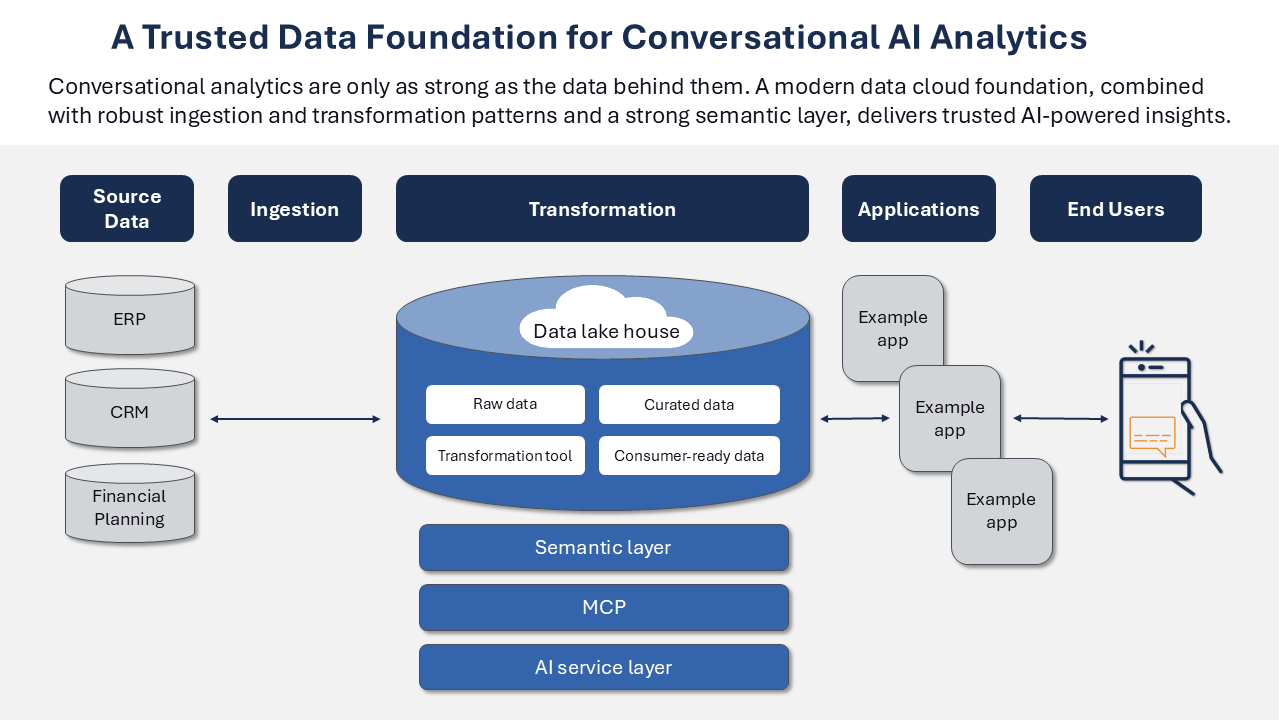
From Raw Data to Business-Ready Data: The Importance of Tiered Architecture
For this use case, we designed and built a medallion architecture in Snowflake. A medallion architecture organizes data into three layers (bronze, silver, and gold) and transforms it from raw data into business-consumable data assets. This approach is essential when you have data coming from over a dozen distinct sources in the form of hundreds of files and several application connections. It ensures solid ingestion patterns and reliable transformations based on well-defined business logic. Curated data assets in the gold/highest layer of the medallion architecture can be used for reporting and dashboarding in tools like Tableau and Power BI. They can also be leveraged in semantic views and models, which is necessary to ensure trustworthy answers when talking to data.
The Semantic Layer: Teaching the Data Model to Speak Sales
The semantic layer has become a hot topic recently because of its connection to enabling AI, but what is it, exactly? In the context of a sales data environment, it:
- maps business terminology to structured data sets;
- handles synonyms, hierarchy logic, and context; and
- aligns seller and territory hierarchies.
In short, it teaches the data model to speak sales and acts as the instruction booklet that tells an agent or chatbot where to find the right answer to the question a sales rep is asking. The semantic layer also plays a critical role in establishing trust by ensuring that different ways of asking the same question lead to consistent, reliable answers.

Exposing this semantic information in the form of a semantic view, however, was only half of the work. We also stood up a Snowflake-managed Model Context Protocol (MCP) server, which allows external clients (like agents coming from other systems) to discover the tools we develop within Snowflake (our Cortex agent), without having to deploy additional infrastructure and support. In our case, we were able to expose the Cortex Analyst agent, backed by our semantic view, as a product. This ensures that the queries generated are correct and executed securely against the data, enabling the sales teams to get the right answer to their questions the first time.
Validating the Conversational AI Experience for Sales
The technical nuances of connecting the semantic layer to external applications can take significant coordination. As more applications are incorporating agentic features, the technical details become even more complex. Leveraging an open-source data application development tool is one quick way to validate the conversational analytics experience within the data environment even while integration and connectivity with the external application is still being established. For this client use case, we were able to quickly develop a functional validation interface using Streamlit, which allowed us to test the accuracy of queries and semantic logic generated from sales reps’ questions. This approach enables controlled validation before wider deployment which allows for iterative incorporation of feedback. It also gives data engineers the chance to refine and customize query responses based on commonly asked natural language questions. Early, iterative testing saves time later, and validated responses build trust, ensuring users can rely on the system as they incorporate it into their daily workflows.
What’s the Payoff of a Conversational AI for Sales Solution?
In the case of our client, once fully deployed, they will benefit not only from expected increases in sales team productivity but also from the scalability of the data architecture behind it. With the solid data foundation and initial semantic model in place, enabling additional use cases—and business value—will be faster and easier.
- Teams have on-the-go access to trusted sales data: The solution pulls certified sales data, consistent with trusted reports and dashboards, into the applications sales reps and sales operations teams use as part of their daily routines.
- Projected savings from sales team efficiency and productivity gains: The conversational AI solution is estimated to deliver an annual value of up to $5M in total cost savings for the pilot region alone. When extrapolated across the global sales force, the cost savings will be even greater.
- Scalability for evolving team needs: The baseline semantic model and configuration can be refined and expanded to customize responses and answer new and evolving questions from sales reps.
- Flexibility for future integrations: Although the initial use case will enable conversational AI for the client’s external CRM application, the semantic layer behind it can be extensible across applications, such as finance and collaboration tools.
Beyond the Chatbot: Unlocking the True Value of Conversational AI
Delivering on the promise of conversational AI analytics for enterprise sales teams requires more than just cutting-edge tools. Ultimately, it comes down to trust—trust in the data, trust in the definitions, and trust in the answers that guide decision-making. Building this trust requires doing the foundational work to ensure those tools can be scaled and embedded seamlessly into the flow of sales activities. By investing in modern data platforms, strong governance, and thoughtfully designed semantic layers, organizations can transform complex data environments into intuitive and trusted conversational experiences. The result is a more empowered sales force—equipped with timely, accurate insights—able to move faster, make better decisions, and drive measurable productivity and revenue impact at scale.
Learn more about how Cleartelligence can help you supercharge business insights with AI.
This is article was edited with the assistance of LLM capabilities.
Answers To Your Data & AI Challenges
Find quick answers to some of the most common questions about AI-powered conversational analytics for sales teams.
How does conversational AI work in a sales team environment?
Conversational AI allows sales teams to ask natural language questions and receive real-time, data-driven answers, providing them with the insights and analytics they need to prepare for meetings, prioritize customer outreach, and make faster decisions.
Why is trust critical to the success of conversational AI analytics solutions?
Trust is essential for adoption because sales teams will only use conversational AI if they believe the answers are accurate and consistent. When data, definitions, and AI-generated insights are reliable, teams are more likely to integrate the tool into their daily workflows—leading to better decisions, higher productivity, and greater overall business impact.
Why is a strong data foundation needed for conversational AI analytics to work effectively?
A strong data foundation ensures that conversational AI can deliver accurate, consistent, and trustworthy answers. Without high-quality, governed data, and modern infrastructure, AI tools may return incorrect or conflicting insights. By investing in cloud platforms, medallion architecture, reliable data pipelines, and well-defined business logic, organizations can enable conversational AI to function effectively and support confident decision-making.
What role does the semantic layer play in conversational AI analytics?
The semantic layer translates business-specific language—in the case of sales, term such as territories, accounts, products, and performance metrics—into structured data. It ensures that sales reps can ask questions in their own terms and still receive consistent, accurate answers, even when phrased differently.
What are the benefits of conversational AI analytics for sales teams?
Sales teams that have access to conversational AI analytics Benefits will benefit from improved productivity, on-the-go access to trusted data, faster decision-making, deeper customer understand, and potential operational cost savings.

Marissa Wilson, Senior Director, Portfolio Management
Marissa is a data and analytics leader with more than 15 years of experience helping organizations leverage technology to turn complex business challenges into scalable, value-driven solutions. With over a decade of industry experience, Marissa leads the Healthcare and Life Sciences portfolio at Cleartelligence, specializing in bridging the gap between business strategy and technology execution. She has a successful track record of leading global, enterprise-wide transformation and modernization programs that drive innovation, enable scalability, and deliver operational efficiency.

Austin Hewlett, Principal Data Advisor
Austin is a data advisor specializing in enterprise data strategy and analytics architecture with experience delivering transformations across technologies including Snowflake, Databricks, and AWS. He focuses on helping organizations scale data capabilities through modern architecture and data product strategy.