
Not anytime soon, but it is reshaping and accelerating how organizations prepare, deliver, and act on insight. The companies who balance AI innovation with human expertise both will lead the way.
Every few months, someone asks me the same question about the us of AI in analytics (usually on a client call or during a company meeting): “With all these new AI tools, are data visualization and business intelligence even going to matter anymore?”
It’s a fair question. The hype is real, and the progress is undeniable. Every major platform now has some form of “AI-powered” feature, and standalone tools can generate charts, insights, or even dashboards with a single prompt. As someone who leads a team of consultants focused specifically on data visualization and analytics, I can tell you that AI isn’t replacing BI. Not now, and not anytime soon.
What’s actually happening is much more interesting: organizations are experimenting with three different approaches to AI in analytics. Some are all-in on new standalone AI tools. Others are leaning into the AI features embedded in the BI platforms they already own. And a third group, maybe the smartest group, is blending traditional analytics with targeted AI capabilities.
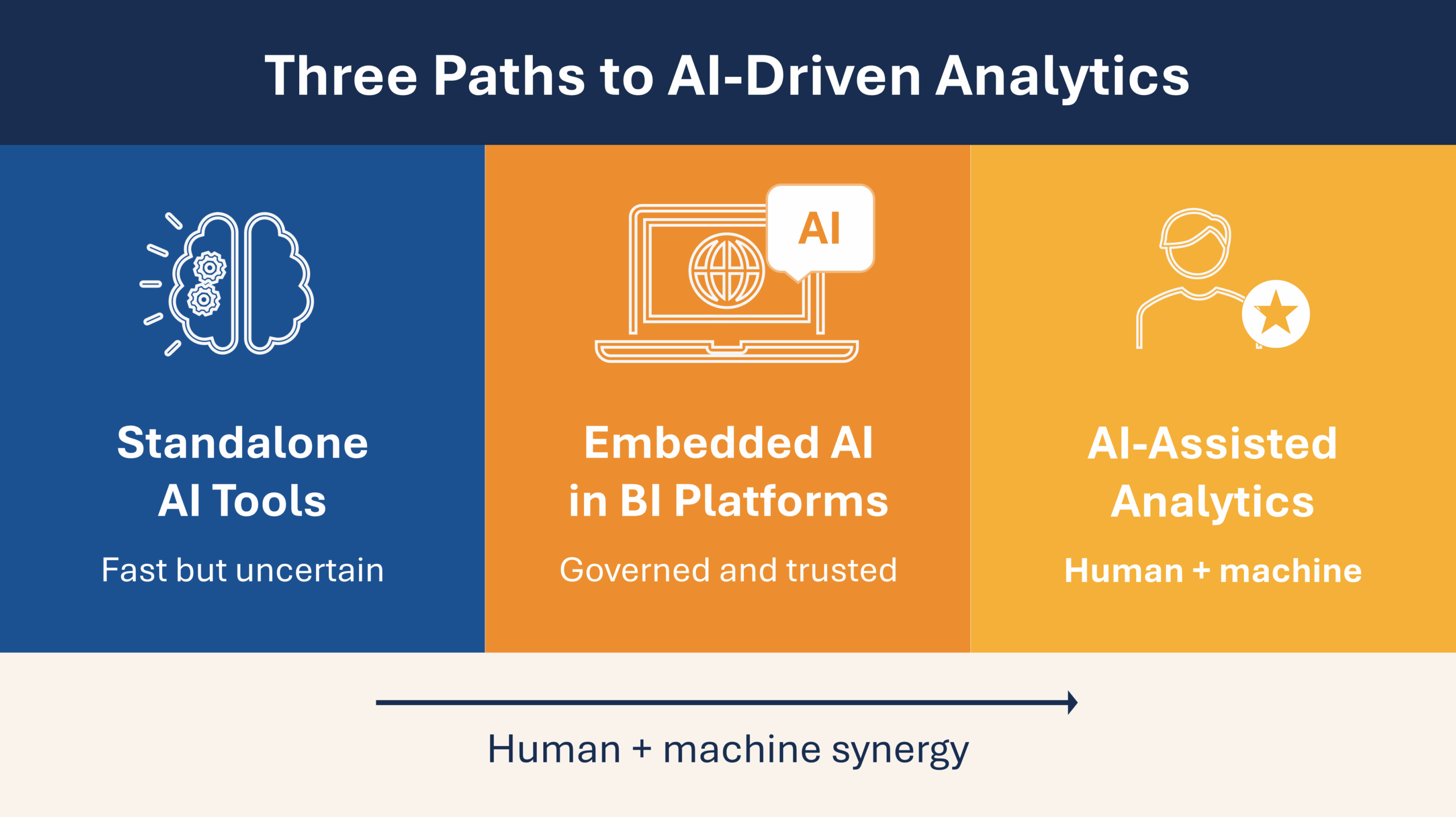
Each of these paths has potential and its pitfalls.
1. Standalone AI Tools
This is the shiny new toy category: The ChatGPTs, the Copilots, the custom LLM-powered dashboards that promise instant answers without all the traditional data prep, modeling, or design work.
The appeal is obvious: instant insights. You just describe what you want, “Show me customer churn trends by region and product line over the past three years,” and a perfectly formatted chart appears. No SQL. No dashboard build. No governance meeting.
The problem? These tools usually live outside the company’s data ecosystem. They don’t know which definitions have been approved, which sources are trusted, or which numbers were adjusted after last quarter’s audit. The data is fast, but it’s often wrong or incomplete, and nobody knows why.
We’ve watched teams chase speed with AI-only tools, only to discover that trust is the real currency of analytics. Anyone can generate an answer, but who’s accountable when it’s wrong? Without governance, context, and human validation, AI’s output can’t be defended or repeated. Insight without this accountability isn’t insight; it’s guesswork.
So while these tools can accelerate early exploration or hypothesis testing, they rarely replace the rigor and context of a proper BI environment.
> Use Case in Action: Standalone AI Tools
A CPG company experimenting with a generative AI dashboard builder asked the tool to analyze sales trends across multiple regions. It quickly produced a visually impressive chart—but the results didn’t seem to match any of the company’s official quarterly reports. After digging deeper, the team discovered that the AI had used outdated staging data and ignored key filters applied in their governed datasets. The insight looked great but couldn’t be trusted. The effort was an expensive reminder that speed without accuracy can derail decision-making.
> What next?
Use of AI Chatbots to provide fast and efficient customer service. Chatbots can understand natural language and provide relevant answers.
2. Embedded AI in BI Platforms
This is where things get interesting and where we’re spending a lot of time with clients right now.
Every major visualization platform is rapidly embedding AI into its experience. Power BI has Copilot. Tableau has Einstein GPT. Qlik has Insight Advisor and AutoML. Each of these tools is taking a slightly different angle, but they share the same goal: to make analytics more conversational, predictive, and accessible. And this category is actually working.
When AI is built into the platforms that already handle your security, governance, and data modeling, it becomes a natural extension of the existing analytics process rather than a competing tool.
We’re seeing clients use embedded AI to:
- Suggest chart types or visualizations based on data context
- Automatically explain trends or anomalies
- Generate draft narratives to accompany dashboards
- Predict future values right inside familiar BI interfaces
The key advantage is that these capabilities sit on top of trusted data models. The governance, permissions, and definitions already exist. That means users can experiment freely without breaking the rules that keep the data credible.
The main challenge right now is expectation management. Embedded AI still needs strong data foundations and human validation. It’s great at accelerating analysis, but not at owning it.
> Use Case in Action: Embedded AI in BI Platforms
One of our manufacturing clients recently rolled out Power BI Copilot for their finance and supply chain teams. Rather than building new dashboards from scratch, analysts began using it to generate quick summaries of anomalies in monthly performance reports. Because Copilot was working within their governed Power BI workspace, the explanations tied back to certified data models and consistent metrics. The effort produced insights faster without compromising the trust they’d spent years, and a lot of hard work, building.
> What next?
The team built off this initial success to develop an embedded AI expansion plan, following a similar pattern of trusted data sources, experimentation, and implementation.
3. Traditional Analytics, Enhanced by AI
Finally, there’s the approach I like to call “AI–assisted analytics.”
With AI–assisted analytics, organizations continue to rely on traditional BI platforms and analytics teams, but they use AI as an accelerator or enhancer, not a replacement. It’s the human–plus–machine model.
In this world, analysts use AI to speed up repetitive tasks: writing calculations, generating starter dashboards, summarizing insights, or cleaning messy data. Data engineers use AI to automate ETL documentation or SQL optimization. Visualization developers use it to brainstorm layouts or even generate test datasets.
AI becomes part of the workflow, not the workflow itself.
This is where a lot of our analytics work for clients is focused on today. They want the speed and creativity that AI provides, but they also understand the importance of governed data, clear definitions, and thoughtful design. They know that the final 10%—,the judgment, storytelling, and empathy that connects data to people—still requires a human touch.
The big takeaway: It’s not AI vs. BI. It’s AI and BI
The companies getting the most out of AI right now aren’t trying to replace their BI platforms. They’re integrating AI into the ecosystem they already trust.
They’re asking questions like:
- How can AI help us move faster within our governed environment?
- How can we empower business users without losing control of data quality?
- Which parts of our analytics process are ready for automation, and which parts still require human interpretation?
This mindset shift is powerful. It moves the conversation from replacement to augmentation. From hype to impact. From “AI will take my job” to “AI just made me faster and better at it.”
> Use Case in Action: Traditional Analytics, Enhanced by AI
A client’s analytics team used AI to automate the first draft of their monthly executive dashboards. The AI leveraged curated, trusted datasets to generate visuals, narrative summaries, and even highlight potential outliers. Analysts then validated, refined, and contextualized the AI output using their domain knowledge to ensure accuracy and credibility before distribution. This approach streamlined their monthly development cycle, cutting days of manual preparation while maintaining the thoughtful storytelling and leadership-level precision their executives expect.
> What next?
The team standardized this AI-assisted “first pass” process across multiple business functions, embedding it into their recurring dashboard development framework. This not only accelerated delivery timelines but also unlocked greater ROI from their existing analytics investments, subsequently freeing analysts to focus on creative problem-solving and strategic data storytelling rather than repetitive data preparation.
What’s Next for AI and Analytics?
We’re at the beginning of a transformation, not the end of one.
AI will absolutely reshape how we design, deliver, and consume analytics. But the organizations that win will be the ones that understand balance: between speed and accuracy, automation and creativity, machine output and human judgment.
At Cleartelligence, our team is already helping clients navigate this balance. Whether that means evaluating new AI tools, enabling Copilot in Power BI, or helping teams understand how to embed AI responsibly into their BI workflows, our goal is the same: to help organizations build smarter, faster, and more human analytics.
Because the future of data visualization isn’t about replacing people. It’s about giving them superpowers.
Learn more about how Cleartelligence can help you supercharge business insights with AI.
This is article was written with the assistance of LLM editing capabilities.